ETF or Investment Fund: Differences in Costs, Diversification, and Taxation for Beginners

If you are deciding between investing via an ETF or through an investment fund, this text explains, in a straightforward way, the essential differences in structure, costs, diversification and taxation. The goal is to provide concepts and practical questions to evaluate products, without recommending buying or selling.
This is general information to guide your research. For personalized decisions, consult a qualified professional. Rules, limits and procedures mentioned can change; official references are listed at the end.
Direct summary (2–3 paragraphs)
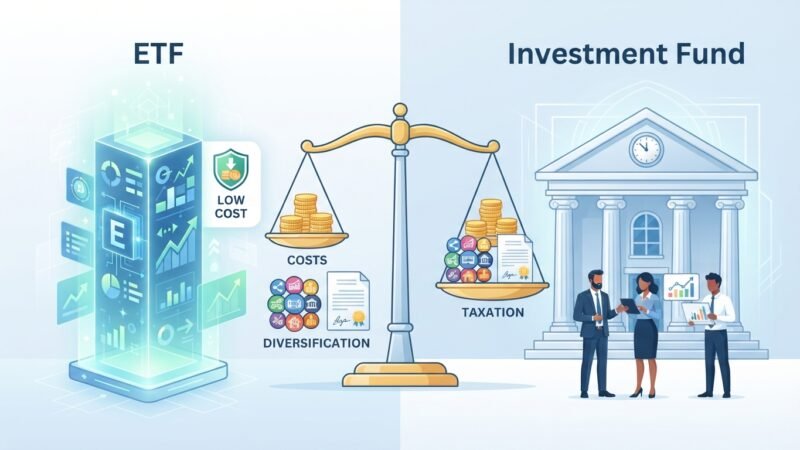
ETFs (Exchange Traded Funds) are exchange-listed funds that track an index and are bought and sold in real time like stocks. In contrast, investment funds (such as open or closed funds) are vehicles whose trading occurs in fund units managed by the manager, with redemption rules and price calculation (net asset value per unit) at a defined frequency.
The main practical difference is the trading mode (exchange versus fund units), the cost profile (spread and brokerage for ETFs; management fees and possible performance fees for funds) and how taxation and liquidity mechanisms apply. Below are practical steps to compare products, common mistakes and questions you should ask when reading the fact sheet or the prospectus/regulations.
Practical steps to compare ETF vs fund
- Identify the strategy: does the ETF replicate an index (e.g., a stock index) or is it an active fund? Check the document to see whether the fund is passive or active.
- Read the fact sheet and the prospectus/regulations: look for the investment policy, administration fee, performance fee, concentration limits and creation/redemption mechanisms (for ETFs).
- Evaluate total costs: for ETFs consider brokerage, spread (difference between bid and ask) and the administration fee. For funds, include administration fee, performance fee and possible load or exit fees.
- Check liquidity: ETFs trade intraday on the exchange; check average volume and the spread. Funds may offer daily, monthly redemptions or specific windows — verify deadlines and any lock-up periods.
- Consider diversification and composition: see whether the ETF tracks a broad or sector index; for funds, assess the objective and the historical portfolio composition.
- Confirm taxation and unit treatment: read the fact sheet and, if necessary, consult the Receita Federal or an accountant; the product classification affects taxes.
- Check the manager, administrator and custodian: these are names and institutions listed in the fact sheet; evaluate their experience and operational track record.
Quick checklist (comparative table)
| Aspect | ETF | Investment Fund (general) |
|---|---|---|
| Trading | On-exchange, intraday (like stocks) | Units traded with the manager/administrator; redemption according to the regulations |
| Common fees | Administration fee, brokerage, spread | Administration fee, performance fee, possible load fees |
| Portfolio transparency | Usually high (ETF discloses composition to replicate an index) | Varies; some funds disclose holdings frequently, others less often |
| Liquidity | Depends on volume and the market maker | Depends on redemption rules and settlement periods |
| Taxation | Depends on the ETF classification and the investor’s operations; check the fact sheet and legislation | Taxation according to the fund type (short/long term, equity, currency, etc.) |
Common beginner mistakes
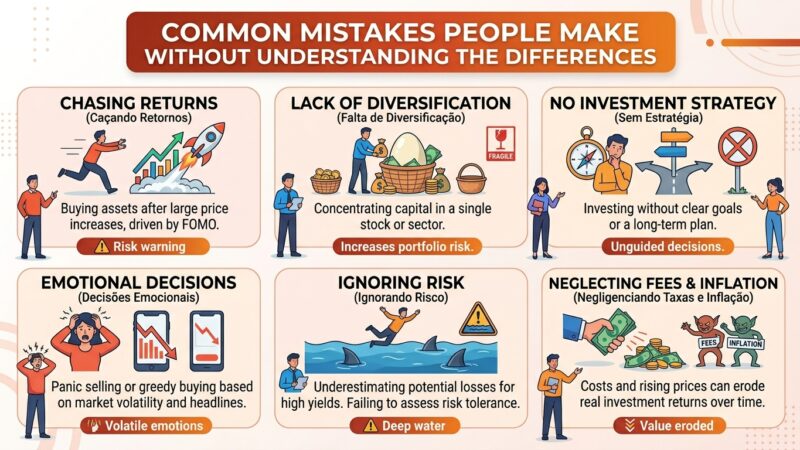
- Focusing only on the administration fee: brokerage and spread (ETFs) or performance fees (funds) also affect net returns.
- Ignoring liquidity: low-volume ETFs can have wide spreads; funds with long redemption windows can restrict access to your money.
- Not reading the fact sheet/prospectus: these documents contain rules on risk, concentration and redemption procedures.
- Confusing product diversification with suitability to personal goals: more assets does not automatically mean a better fit for your plan.
Important limits and risks
All investments involve market risk and counterparty credit risk. ETFs track indexes and may show tracking error (the difference between the ETF’s performance and the index). Active funds depend on the manager’s skill.
Liquidity risk can affect execution and pricing in both cases.
The rules for operation and supervision are set by the Comissão de Valores Mobiliários (CVM) and ETFs trade on B3; procedures, limits and forms can change, so always consult the official sources.
Questions to ask when reading the fact sheet / prospectus
- What is the fund’s objective and which index (if any) does it track?
- What are all the fees charged (administration, performance, custody, brokerage)?
- How do creation/redemption (for ETFs) and redemption windows (for funds) work?
- What is the portfolio disclosure policy and how often is it updated?
- Which risks are highlighted in the document (concentration, counterparty, liquidity)?
- Who are the manager, the administrator and the custodian?
- How is taxation handled at the vehicle level and for the unitholder?
Frequently asked questions
- Is an ETF better than a fund? It depends on your objective, horizon, liquidity needs and tolerance for costs; you cannot generally state that one is superior to the other.
- Can I buy an ETF through my broker? Yes — ETFs are traded on the exchange; check your broker’s availability and fees.
- How do I see the real fees? Consult the fact sheet/prospectus and add administration, brokerage, spread and potential performance fees to assess the total cost.
- Where can I check rules and supervision? The CVM sets rules for funds and B3 details ETF trading; official links are in the sources section.
Sources and updates
Official documents and pages consulted (rules can be changed by the entities themselves):
- Comissão de Valores Mobiliários (CVM) — regulation and guidance on investment funds. Menus, limits and procedures can change.
- B3 — page about equity ETFs — information on ETF trading on the exchange. Menus, limits and procedures can change.
This content is informational and does not replace individual professional advice.

Michael Rowan is a dedicated writer and researcher specializing in Personal Finance and Investments. With a passion for helping individuals make smarter financial decisions, he creates informative and practical content designed to simplify complex financial topics.