
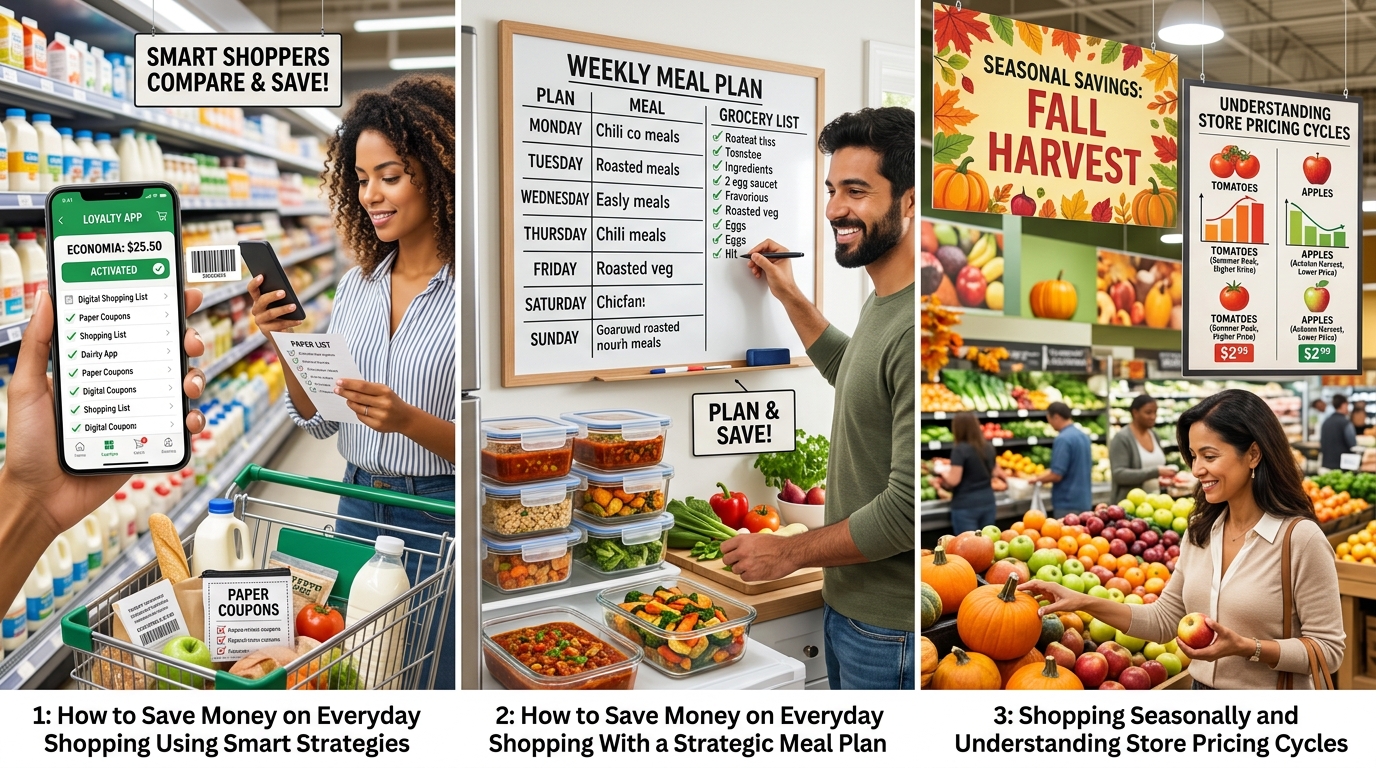
How to Save Money on Everyday Shopping Using Smart Strategies
|
Getting your Trinity Audio player ready...
|
Let’s be honest — most of us leave money on the table every single week without even realizing it. Whether you’re grabbing groceries, refilling household supplies, or picking up something for the kids, the way you shop has a massive impact on your bank account. Learning how to save money on everyday shopping isn’t about clipping coupons from a Sunday newspaper anymore.
It’s about building smarter habits that fit your actual lifestyle. And once you start applying these strategies, the savings add up faster than you’d expect.
The good news is that you don’t need to sacrifice quality or completely overhaul your routine to see real results. Small, deliberate changes in how you plan, shop, and pay can easily save you hundreds of dollars a month. This guide walks you through practical, field-tested methods that go well beyond the obvious “buy store brands” advice.
We’re talking about behavioral shifts, technology tools, and insider knowledge that will genuinely change how you approach your wallet every week.
Whether you’re shopping for a family of five or just yourself, the principles here are universal. Understanding how to save money on everyday shopping is ultimately about making intentional decisions instead of reactive ones. Let’s dig in.
Why Most People Overspend Without Knowing It
Before jumping into tactics, it helps to understand why saving feels so hard in the first place. Retail environments — both physical and digital — are engineered to get you to spend more than you intended. End caps in grocery stores feature high-margin products, not the best deals.
Online stores use countdown timers and “only 3 left in stock” warnings to trigger urgency. Flash sales condition you to feel like you’re always missing out. These aren’t accidents; they’re deliberate psychological triggers backed by decades of consumer research.
One of the biggest culprits is what behavioral economists call present bias — the tendency to prioritize immediate comfort over long-term financial health. That impulse buy at checkout? That extra item you threw in because it was “on sale”? Present bias at work. Recognizing this pattern is the first step toward overcoming it.
When you understand how the system is designed against you, you can start designing your own system that works in your favor.
Another common trap is mistaking discounts for savings. A product that’s 40% off is only a saving if you actually needed it. Otherwise, you’ve spent money you wouldn’t have spent at all.
Learning how to save money on everyday shopping means reframing what a “good deal” actually looks like. It’s not about price reduction — it’s about value relative to your needs.
How to Save Money on Everyday Shopping With a Strategic Meal Plan

Groceries are typically the largest variable expense in a household budget, and they’re also one of the most controllable. The single most effective thing you can do is plan your meals before you step foot in a store or open a delivery app. When you walk in without a plan, you’re making dozens of micro-decisions under the influence of hunger, marketing, and time pressure.
When you walk in with a list built from a weekly meal plan, you buy exactly what you need — nothing more, nothing less.
Start by building a rotating library of meals your household actually enjoys. Aim for about 10 to 15 core recipes that share overlapping ingredients. For example, if you’re making chicken stir-fry on Monday, plan a chicken soup or wrap for Wednesday using the same protein.
This reduces waste dramatically and allows you to buy ingredients in larger, cheaper quantities. A head of cabbage, for instance, can serve three different meals across the week if you plan it that way.
Once your meal plan is set, build your shopping list by category: produce, proteins, dairy, pantry staples. This approach not only speeds up your time in the store but prevents you from wandering aisles and tossing things in the cart on impulse. Research consistently shows that shoppers who enter stores with a written list spend significantly less than those who don’t.
Apps like Mealime or Equally important: shop on a full stomach. Studies have shown that hungry shoppers buy more calorie-dense foods and spend more overall. It sounds almost too simple, but this one habit shift genuinely affects your total at checkout.
Pair it with a firm commitment to your list, and you’ll start to see consistent results. These foundational behaviors are what make how to save money on everyday shopping work in real life rather than just theory.
Mastering Price Tracking and Cashback Tools
Technology has genuinely leveled the playing field between consumers and retailers. There are now dozens of free tools that do the heavy lifting of price comparison, cashback collection, and coupon stacking for you. The key is knowing which ones are actually worth your time and how to layer them effectively.
Using even two or three of these tools consistently can shave 10–20% off your regular spending without requiring extra effort.
Price tracking tools like CamelCamelCamel (for Amazon) and Cashback apps and browser extensions are perhaps the easiest wins available. Tools like Ibotta, and Another underused tactic is stacking rewards. When you combine a cashback credit card, a store loyalty program, and an app like Rakuten for the same purchase, you’re earning in three places simultaneously. This is perfectly legal and often encouraged by retailers.
The discipline required is simply making sure you pay your credit card balance in full each month so that interest charges don’t wipe out your rewards. Used responsibly, a 2% cashback card on a $500 monthly grocery budget returns $120 per year — before stacking any other offers.
Buying in Bulk the Smart Way
Bulk buying is one of the most talked-about strategies for how to save money on everyday shopping, but it’s also one of the most misunderstood. Done right, it can slash your per-unit costs dramatically. Done wrong, it can lead to food waste, cluttered storage, and spending money upfront on items you didn’t actually need.
The difference comes down to buying the right things in bulk — not just buying more of everything.
The best candidates for bulk purchasing are non-perishables and items you use consistently in large quantities. Think: toilet paper, paper towels, dish soap, laundry detergent, canned goods, dried beans, rice, oats, and coffee. These items have long shelf lives, won’t go to waste, and show significant per-unit savings at warehouse stores like Costco or Sam’s Club.
On the other hand, buying a 10-pound bag of a fresh vegetable you might use once a week rarely saves money — most of it ends up in the trash.
Before making a bulk purchase, calculate the true unit cost and compare it to your regular store. Sometimes warehouse prices aren’t actually lower once you factor in membership fees. Divide the total cost by the number of units (ounces, sheets, servings) to get a consistent comparison point.
You might find that your local store’s sale price beats the warehouse club’s bulk price, especially on items like name-brand cereals or certain condiments.
Also consider splitting bulk purchases with a neighbor, family member, or friend. This is particularly smart for perishable bulk items — a giant block of cheese from Costco, for instance, is a great deal but only if you can actually get through it before it molds. Splitting it means you each get the bulk discount without the waste risk.
This informal buying-club approach is an underrated extension of traditional bulk strategy and genuinely helps you how to save money on everyday shopping without the typical downsides.
Shopping Seasonally and Understanding Store Pricing Cycles
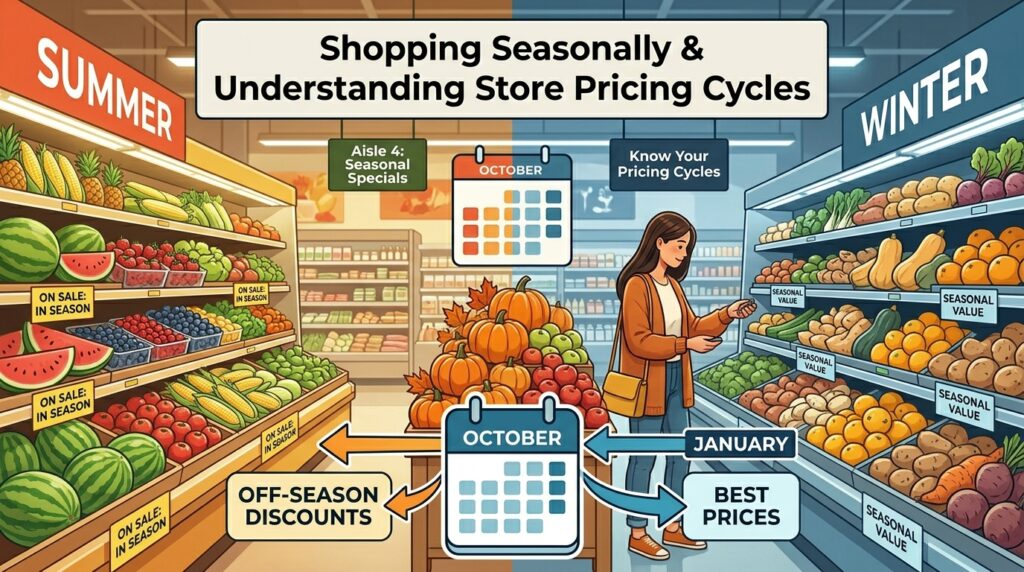
Most people shop based on what they want to eat right now. Seasoned frugal shoppers think differently — they buy based on what’s cheapest today and plan their consumption around that. This mindset shift, while it takes some getting used to, is one of the most powerful ways to reduce your grocery bill without sacrificing the quality of what you eat.
Seasonal produce is the clearest example: strawberries in June cost a fraction of what they do in January. Butternut squash in October is virtually free compared to March pricing.
Beyond produce, understanding how store sales cycles work gives you a significant edge. Most supermarkets rotate their major sales on a 4–6 week cycle. Ground beef goes on sale, then chicken, then pork, cycling through predictably.
If you pay attention and keep a rough price book — even just a note on your phone tracking what you normally pay for key items — you’ll know when a price is genuinely a good deal versus a routine markup disguised as a discount.
Stores also mark down products strategically throughout the day and week. Many grocery stores reduce meat and bakery items in the late evening before closing or early morning, particularly on items approaching their sell-by date. These markdowns can be 30–50% off the regular price, and the food is perfectly fine — it simply needs to be cooked or frozen that day.
Learning your local store’s markdown schedule and building it into your routine is a legitimate, under-the-radar way to how to save money on everyday shopping consistently.
Clothing, electronics, and household goods follow their own seasonal patterns. Major appliances are cheapest in September and October when new models arrive. Winter clothing hits its lowest prices in January and February.
Back-to-school supplies are obvious, but fewer people know that office supplies follow the same cycle. If you can buy ahead of need and store items (within reason), buying off-season delivers savings that in-season shoppers simply never access.
Building a Price Book and Knowing Your Numbers
The concept of a price book dates back decades, but it’s more relevant than ever in a world where prices shift constantly and “sale” is a relative term. A price book is simply a record of what you normally pay for the items you buy most often. It doesn’t need to be elaborate — a notes app on your phone, a simple spreadsheet, or even a small notebook will do.
The goal is to create a reference point so you always know whether a deal is genuinely good.
Start by tracking the prices of your top 20–30 most frequently purchased items across the stores you shop most often. Note the regular price and the sale price. After a few weeks, patterns emerge.
You’ll notice that certain items regularly drop to a particular floor price, which tells you the best you should expect to pay. When that price appears, that’s your signal to buy enough to last until the next cycle. When prices are high, you skip it and live off your stockpile.
This approach requires an upfront investment of time and attention but pays compounding dividends. Once you’ve built a solid price book, you stop making decisions based on gut feel and start making them based on data. That shift alone can reduce your weekly shopping bill by 15–25% without changing what you eat or where you shop.
It’s one of those habits that feels tedious to start but becomes second nature within a month — and it fundamentally changes how you think about how to save money on everyday shopping.
Reducing Food Waste to Stretch Every Dollar Further
Here’s a number that should shock you: the average American household throws away nearly $1,500 worth of food each year. That’s money you already spent, food you already carried home, just quietly decomposing in your fridge or garbage bin. Reducing food waste is one of the most overlooked dimensions of grocery savings because it doesn’t happen at the store — it happens at home.
But the financial impact is just as real.
The root cause of most food waste is poor visibility. When produce is buried at the back of the fridge behind leftovers and condiments, it’s out of sight and out of mind until it’s too late. The fix is simple: organize your refrigerator so that items closest to expiration are front and center.
Many families adopt the “FIFO” method used in restaurant kitchens — First In, First Out — placing newer items behind older ones so older ones get used first.
Learning a handful of flexible, “clean the fridge” recipes dramatically reduces waste. Frittatas, stir-fries, soups, and grain bowls are all designed to absorb whatever vegetables or proteins you have on hand. Once a week — usually the day before a big shopping trip — commit to cooking from what you already have rather than buying something new.
Not only does this save money directly, it also prevents you from buying duplicates of things you forgot you already had.
Freezing is your most powerful anti-waste weapon. Bread going stale? Freeze it. Chicken you won’t cook in time? Freeze it before the use-by date.
Herbs about to turn? Blend them with olive oil and freeze in ice cube trays for instant cooking flavor later. Bananas getting too ripe? Peel and freeze them for smoothies. Learning to use your freezer proactively rather than reactively transforms perishables into long-term assets, stretching every dollar you spent at the store further than you thought possible.
Practical Tips You Can Apply This Week
- Switch to store brands on at least five items — start with pantry staples like flour, sugar, canned tomatoes, pasta, and cooking oil. The quality difference is negligible, but savings are typically 20–40%.
- Install the Honey browser extension before your next online purchase — it automatically scans for coupon codes at checkout in seconds.
- Check your store’s app for digital coupons before shopping — most major chains have app-exclusive discounts that don’t appear on shelf labels.
- Set a weekly grocery budget and use cash or a prepaid card — the physical reality of a finite amount of money is a powerful psychological constraint that prevents overspending.
- Do a “pantry challenge” once a month — spend a full week shopping only for fresh produce and proteins, using only what’s already in your pantry, fridge, and freezer for everything else. Most families are shocked by how much food they already have.
- Compare prices per unit, not per package — many stores show the unit price on the shelf label. If yours doesn’t, use your phone’s calculator. A larger package isn’t always cheaper per ounce.
- Avoid shopping hungry, tired, or rushed — each of these states impairs decision-making and increases impulse purchases. Set yourself up for success by shopping at a calm, planned time.
- Unsubscribe from retail marketing emails — unless you have specific items on your radar, promotional emails exist to create desire for things you didn’t previously want.
The Long Game: Building Frugal Shopping Habits That Stick
The strategies outlined here aren’t magic tricks that work once. They’re habits, and habits require repetition before they become effortless. The most important thing you can do is pick two or three strategies that resonate most with your lifestyle and implement them consistently for 30 days before adding more.
Trying to overhaul everything at once leads to overwhelm and backsliding. Small, consistent wins compound over time into major financial shifts.
Think of it this way: if you save an average of $150 per month through smarter shopping habits — a very achievable number — that’s $1,800 per year. Invested at a modest 7% annual return, that grows to over $25,000 in 10 years. The choice to learn how to save money on everyday shopping isn’t just about what you spend at the checkout line today.
It’s about the financial future you’re building every single time you decide to shop with intention rather than impulse.
It’s also worth tracking your progress explicitly. Keep a simple log of what you spent each month on groceries and household goods. Seeing the numbers trend downward — even modestly — provides powerful reinforcement to keep going.
Many people find that the habits eventually become a source of pride and even enjoyment. There’s a genuine satisfaction in getting exactly what you need for significantly less than you used to pay. That mindset transformation is, ultimately, the real secret behind how to save money on everyday shopping.
So whether you’re just starting out or looking to tighten up an already disciplined budget, the tools are all here. Start with your next shopping trip. Bring a list.
Eat before you go. Check the cashback apps. Compare the unit prices.
These aren’t extraordinary measures — they’re just smart ones. And over time, smart adds up to something significant.
Frequently Asked Questions
How much money can I realistically save by changing my shopping habits?
Most households can save between $100 and $300 per month by implementing a combination of meal planning, cashback tools, strategic bulk buying, and waste reduction. The exact amount depends on your current spending patterns and how many strategies you apply consistently.
Is buying in bulk always cheaper?
Not always. You need to calculate the per-unit cost and compare it to your regular store prices, factoring in any warehouse club membership fees. Non-perishable staples you use frequently are almost always cheaper in bulk.
Perishables or items you use infrequently may not be worth the larger upfront cost.
Are store brands really as good as name brands?
For most pantry staples, cleaning products, and basic grocery items, the quality is identical or negligibly different because many store-brand products are manufactured by the same companies as name brands. For specialized items like certain medications or technology products, name brands may offer meaningful advantages — but for everyday groceries, store brands are an easy win.
How do I avoid food waste without spending hours in the kitchen?
Focus on two things: visibility (organize your fridge so soon-to-expire items are in front) and flexibility (learn 3–4 adaptable recipes like stir-fry, soup, or egg dishes that absorb whatever you have on hand). These two habits alone will dramatically reduce what you throw away each week.
What’s the best cashback app for groceries?
Ibotta is widely considered the strongest option for in-store grocery cashback in the US. Fetch Rewards is a close second and requires even less effort — just scan any receipt. For online purchases, Rakuten offers the broadest retailer coverage and a strong cashback rate structure.
Should I use a credit card for shopping to earn rewards?
Only if you pay the full balance every month without fail. If you carry a balance, interest charges will far exceed any rewards earned. For disciplined users who pay in full, a 1.
5–2% cashback card on all purchases is a straightforward, passive way to reduce your effective shopping costs.
What strategies have made the biggest difference in your own shopping budget? Have you tried any of these tactics before, and what was your experience? Share your thoughts and tips in the comments below — your insight might help someone else save their first $100 this month!

Michael Rowan is a dedicated writer and researcher specializing in Personal Finance and Investments. With a passion for helping individuals make smarter financial decisions, he creates informative and practical content designed to simplify complex financial topics.